


Review Us
Secondary International Schools in Bali 2026 - Students study in a modern classroom at an international campus in Bali.
author-2

Early Years to Secondary in Bali for Families – International Schools Across the Island

Moving families struggle with finding continuous education. Switching schools often causes stress for children. Logistics like school runs become a burden for working parents during relocation to the tropical region.

Long commutes and heavy workloads overwhelm children. Parents spend hours in traffic instead of focusing on their careers. Academic success suffers without a consistent home routine and professional logistical support.

Busy parents fail to manage homework and extracurricular schedules. Children arrive home exhausted and unorganized. This lack of structure hinders their growth in a new environment during their formative years.

Refer to Official Tourism Indonesia for general travel standards. Vetted nannies manage the daily school-to-home pipeline. They handle drop-offs and homework while you focus on your professional life.

Expert support makes international education accessible. Caregivers provide the stability children need to thrive academically. This partnership allows you to enjoy expat life without the constant stress of logistics.

A consistent routine is vital for long-term success. Professional nannies ensure your children remain calm and focused. This support makes relocation a positive family experience for everyone in Indonesia.

Full Pathway Education Across the Island

Top educational institutions in the region offer a continuous track from age three to eighteen. This allows children to stay in one community for their entire school life. Consistent environments reduce anxiety and promote better social bonds.

Schools are grouped around Sanur, Canggu, Denpasar, Ubud, and Umalas. Most campuses provide modern facilities like science labs and sports fields. These locations cater to families living in the southern and central districts.

A babysitter in Bali provides essential help with daily transport to these areas. They manage the early morning prep so children arrive at the campus on time. This consistency supports a child’s focus during the day.

Choosing a school with a full academic track simplifies family life. You do not have to research new institutions every few years. Your children grow alongside the same peer group in Indonesia.

Campuses often include play areas for younger kids and study lounges for teens. These spaces are designed for specific age groups. Modern security ensures a safe learning environment for everyone.

International education in Bali is diverse and growing. New facilities open regularly to meet the needs of the expat community. Families find many options that align with their personal values.

Vetted caregivers help children adjust to these large campuses. They provide emotional support during the first few weeks of enrollment. This assistance is vital for a smooth transition to a new school.

Curricula and Continuous Academic Tracks

Secondary International Schools in Bali – IB and British curriculum pathways, IGCSE preparation, and global academic standards

Academic tracks usually follow international standards. The International Baccalaureate is a popular choice for many institutions. It provides a global qualification for university entry and higher education placement.

British-style schools use the English National Curriculum. Students prepare for IGCSE exams in their middle years. They move to A-Levels or the IB Diploma for their final two senior high school years.

School Name

Curriculum Type

Age Range

Bali Island School

IB Continuum

3 to 18 Years

Canggu Community School

IB Diploma

3 to 19 Years

Australian Independent School

Australian / IB

3 to 18 Years

ProEd Global School

British Curriculum

5 to 18 Years

Australian curriculum schools follow their national framework. They aim for recognition in Australia and other English-speaking systems. This is ideal for families planning to return to the southern hemisphere.

A babysitter in Bali supervises the homework requirements for these rigorous programs. They ensure children complete their daily tasks without stress. This help allows students to master difficult subjects efficiently.

Academic rigor increases as children enter the older years. Consistent home support becomes more essential during this time. Professional nannies create a quiet environment for focused study and research.

Schools often provide detailed handbooks about their specific curricula. Parents should review these documents during the admission phase. Understanding the academic expectations helps you prepare your children for success.

Curriculum choice impacts university placement options later. Most programs are recognized by top universities worldwide. Your children receive a high-standard education in a tropical setting.
Early Years Foundations and babysitter Support

Early learning centers focus on play-based development for children aged eighteen months to five years. Programs are often influenced by Montessori or Reggio Emilia methods. These foundations encourage socialization and foundational numeracy skills.

Nannies in Bali help with the physical needs of toddlers during this stage. They manage naps, feeding schedules, and clothing changes. This support ensures children are rested and ready for school activities.

Transitioning to a formal classroom is a major milestone for young kids. A dedicated caregiver provides a familiar face during drop-off and pick-up. This reduces separation anxiety and builds confidence in the child.

Early years classrooms are often smaller to allow for personalized attention. Teachers focus on language acquisition and creative projects. Your babysitter can continue these learning games at home after school.

Morning routines are simplified when you have professional help. Caregivers pack the school bags and prepare healthy snacks. This allows parents to start their work day without logistical stress.

Consistent routines at home reinforce the lessons learned in school. Nannies manage the evening wind-down to ensure enough sleep. Quality rest is essential for a child’s cognitive and emotional growth.

Many schools in Bali offer trial days for new preschoolers. This allows the child to experience the environment before full enrollment. Your caregiver can accompany the child during these orientation sessions.

Primary Years Development and Daily Logistics

Primary education emphasizes literacy and numeracy for children aged six to eleven. Students participate in inquiry-based projects and creative arts. The workload increases gradually as they move through the grades.

A babysitter in Bali organizes the daily kit for school activities. They ensure children have their PE kits, library books, and art supplies. This organization prevents last-minute rushes in the morning.

After-school activities are a common part of the primary experience. Children join sports teams, music lessons, or swimming clubs. Caregivers manage the transport and timing for these extra commitments.

Healthy snacks are vital for maintaining energy levels throughout the day. Your babysitter prepares nutritious meals that meet school health policies. This supports the child’s physical well-being and academic focus.

Homework becomes a regular requirement in the upper primary years. A caregiver supervises the study time and ensures tasks are finished. They provide a calm presence that makes learning at home positive.

Traffic in Bali can be unpredictable during school run hours. Nannies manage the commute so children arrive safely and on time. This allows parents to focus on their own professional schedules.

School events often require parent participation or specific costumes. Your babysitter helps prepare these items and manages the schedule. This support keeps the family organized during busy school terms.

Real Story: Sofia’s Academic Success in Umalas

Sofia is a sixteen-year-old student from Australia. She lives in the Umalas neighborhood and attends a high-standard institution. She faced a heavy workload during her first year of the IB Diploma.

The academic expectations at schools were higher than her previous school. Sofia struggled to balance her subject reviews with daily chores and meal prep. She felt overwhelmed and tired.

Her parents hired a babysitter in Bali through our service. The caregiver organized a quiet study space and managed her daily nutrition. Sofia received healthy snacks and consistent rest periods every afternoon.

The babysitter also handled all the transport for Sofia’s extracurricular swimming. This gave Sofia an extra hour of study time each day. She arrived at school feeling organized and mentally prepared for her exams.

Sofia successfully completed her first semester with high marks. Her stress levels decreased significantly because her home life was structured. The professional support allowed her to focus entirely on her education.

Her parents now have more time to focus on their businesses. They trust the babysitter to manage the school-to-home pipeline. This partnership has made Sofia’s high school years a positive and successful experience.

Academic Rigor in Senior High School Years

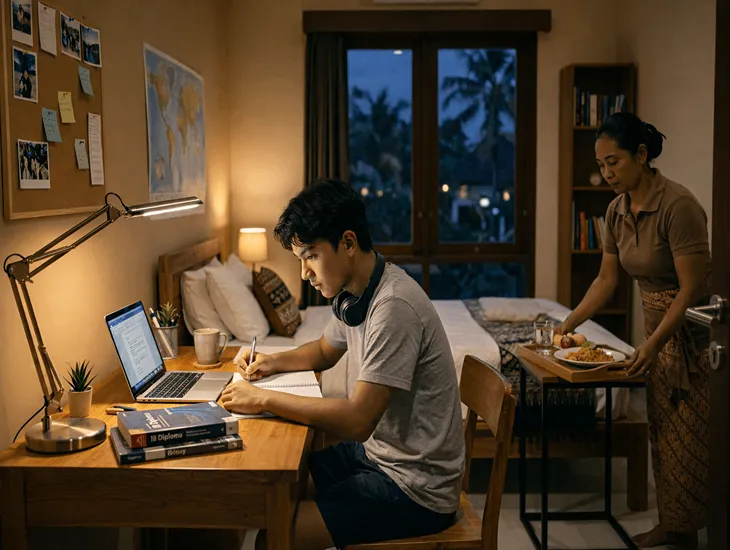
IB Diploma Programs in Bali 2026. High school students preparing for exams with the support of a dedicated caregiver.

Secondary years for students aged twelve to eighteen are academically demanding. Programs like the IB Diploma or A-Levels require significant study time. Students must manage multiple subjects and complex projects simultaneously.

Academic support in Indonesia often includes home-based study management. Nannies shift their role to providing life support for busy teenagers. They ensure the home remains quiet during intensive exam periods.

Caregivers manage the household routines so teens can focus on their goals. They prepare healthy meals and manage laundry and cleaning. This reduces the mental load on students during their final years.

International schools in Bali provide university advisory services for senior students. Parents must attend meetings and review application documents. Your babysitter manages the needs of younger siblings during these times.

Stress management is essential for students in rigorous academic tracks. Professional nannies monitor sleep patterns and encourage healthy breaks. This support prevents burnout and maintains long-term student wellness.

Study spaces must be organized and free from distractions. Your caregiver keeps the desk area clean and well-stocked with supplies. A tidy environment promotes better focus and academic productivity for teens.

Extracurricular activities continue to be important for university applications. Nannies manage the logistics for internships or sports competitions. This allows students to build a strong profile for their future.

Admissions Process and Financial Planning

Enrolling requires careful planning. Most institutions follow a clear process of enquiry, visit, and interview. You should start the application six to twelve months in advance to secure a place.

Families must provide previous school records and valid passports. Student visas or KITAS are often required for final enrollment. Refer to The Jakarta Post for news on Indonesian immigration and education trends.

Financial planning is vital when choosing a school in Bali. Headline fees often exclude uniforms, trips, and capital levies. Total yearly costs can be significantly higher than the initial quote.

Fee Category

Description

Timing

Application Fee

One-time payment for processing

Upon Enquiry

Tuition Fee

Annual or term-based cost

Every Term

Capital Levy

Contribution for facility growth

Annual

Uniforms

Daily and sports wear

Start of Year

Nannies in Bali manage the children during campus tours and interviews. This allows parents to focus on the meetings with admissions staff. Your caregiver ensures the kids stay calm during the long process.

Waiting lists are common for the most popular international campuses. You should apply to multiple schools to secure a place. Your babysitter manages the kids’ routine while you handle the paperwork.

Accreditation signals that a school meets global academic standards. Look for schools recognized by CIS, WASC, or the IB Organization. These credentials ensure your child’s education is transferable and high quality.

Admissions staff are usually very helpful during the transition. They provide orientation for new families and student buddies. Your caregiver helps the child prepare for their first day with the right gear.

Choosing the Right Neighborhood and Campus

Neighborhood choice impacts the daily school run significantly. Traffic in the southern districts can be very heavy during peak hours. Choosing a villa near your preferred campus is wise.

Canggu is ideal for families attending Canggu Community School. Sanur provides easy access to Bali Island School and other institutions. Umalas is a central hub for ProEd and the Australian school.

A babysitter in Bali manages the school and runs through the narrow streets. They understand the local traffic patterns and shortcuts. This expertise ensures children are not sitting in a car for too long.

Proximity to campus allows children to join more after-school clubs. It reduces the time spent on transport and increases play time. Your caregiver manages the transition from school to home efficiently.

Some schools offer bus services for certain neighborhoods. Parents should confirm the routes and costs during the enquiry phase. Nannies can meet the bus and walk children home safely.

Living in a family-oriented area provides more social opportunities for kids. You find many expat communities near the top international schools. This support network is essential for a happy life in Indonesia.

Vetted caregivers help you settle into your new neighborhood. They identify the best local parks and shops for the kids. This local knowledge helps the whole family adjust to their new home.

FAQs about Secondary International Schools in Bali​

Q: What is the age range?

A: Most schools accept children from age three up to eighteen.

Q: Do I need a babysitter?

A: A babysitter in Bali manages school runs and homework for busy families.

Q: Are schools accredited?

A: Yes. Top campuses hold IB, CIS, or WASC credentials.

Q: Is the IB Diploma common?

A: Yes. The IB is the most frequent high school qualification in the region.

Q: When should I apply?

A: Start the process six to twelve months before you plan to enroll.

Q: Are there waiting lists?

A: Yes. Popular campuses in Sanur and Canggu often have waiting lists for students.

If you need a trusted babysitter to care for your little ones while you explore Secondary International Schools in Bali, chat with our team on WhatsApp now!