
Kuta Beach: The Best family-friendly surfing beach in Bali for Beginners
Finding safe environments for children to learn water sports is challenging. Coastal locations often feature strong currents or sharp reefs. This creates physical risks for inexperienced swimmers.
Unpredictable ocean conditions deter parents from booking professional lessons. Fear of minor injuries makes holiday planning difficult. Vacations become stressful without verified safety infrastructure. Consult water safety guidelines for aquatic activities.
Putting children in advanced wave zones causes panic. A severe wipeout on a hard reef ruins beginner confidence. This negative experience discourages future participation in the sport.
Without strict supervision, young learners drift into crowded surfing lanes. This lack of control increases collision probabilities. It transforms a simple lesson into a safety risk for families.
Choosing a suitable shoreline provides necessary structure for learning. Soft sand bottoms and manageable whitewater safely reduce risks. Parents monitor daily progress from a secure shoreline position.
Reviewing official tourism standards helps you select verified locations. Kuta offers extensive lifeguard coverage and professional schools. This destination delivers a secure learning environment for your children.
Table of Contents
Why Kuta is Ideal for Beginners in Bali
Kuta features a classic beach break with a soft sand bottom. This specific geography creates exceptionally gentle and rolling waves. These conditions present the safest environment for novice riders.
The expansive coastline provides ample lateral space for learners. This reduces the density of active students in a single area. Less crowding minimizes the chance of accidental collisions.
Reputable training schools operate directly on the beach sand. Instructors provide dedicated soft-top boards and structured safety briefings. These professionals understand the physical limitations of children.
Age-Appropriate Lessons in Indonesia
Toddlers and young preschoolers must remain on the dry sand. The active ocean current is too strong for independent play. Parents should strictly use the area for shoreline relaxation.
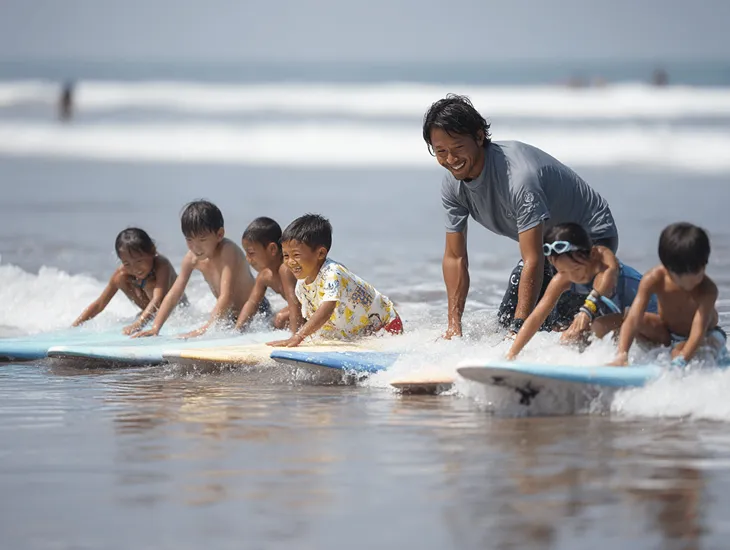
Children aged six to twelve can join dedicated beginner programs. Professional instructors utilize extremely small groups to ensure constant supervision. Kids stay exclusively in the shallow whitewater.
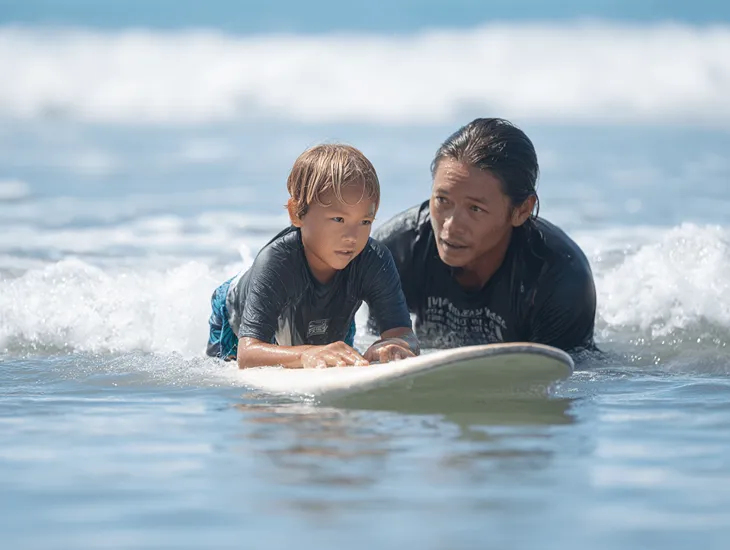
These junior sessions require children to stay within immediate arm’s reach. Instructors gently push the boards to help kids catch the foam. This builds fundamental balance without physical strain.
Navigating Waves and Bottom Characteristics
The lack of sharp coral makes this area superior for learning. Beginners frequently fall off their rented boards during initial attempts. A sandy floor prevents severe lacerations and bruises.
Incoming ocean swells break very slowly across the shallow gradient. This mechanical action provides a long ride in the white foam. Students have more time to correct foot placement.
Daily tides heavily influence the speed and absolute power of the water. Professional instructors schedule beginner sessions exclusively during the mid-tide window. This specific timing ensures the current remains manageable.
Safety Infrastructure and Lifeguards
A highly comprehensive lifeguard network monitors the main swimming and surfing zones. Tall watchtowers are positioned at regular intervals along the coastline. These trained officials enforce strict water boundaries daily.
Certified surfing instructors begin every session with a dry-land safety briefing. They explain rip current identification and basic water etiquette. This theoretical knowledge is mandatory before ocean entry.
Approved schools supply high-visibility rash guards to all active class participants. This bright uniform allows parents and instructors to track children easily. It also provides a necessary barrier against radiation.
Real Story: Diego's Surf Experience
Diego (38, Spain) lived in Sanur and required a safe location for his eight-year-old son to learn surfing. He found that the sharp reef breaks in his area posed severe physical risks for a beginner. He sought professional assistance to find a location with a soft sand bottom.
Managing his son’s fear of deep water was a challenge for Diego when booking a surf lesson. He refused to risk a negative first experience on a hard coral reef. He needed a verified strategy to build his son’s aquatic confidence.
Diego traveled to Kuta and hired a professional assistant from Nanny in Bali to manage logistics on the sand. This allowed him to coordinate directly with the instructors. His son learned safely on a soft-top board in waist-deep water.
Logistics: Surf Schools in Bali
Standard beginner surf packages typically last for two continuous hours. This specific timeframe strongly prevents severe muscle fatigue in young participants. The structure includes theory and guided ocean practice.
Lesson prices average roughly thirty dollars for a comprehensive group session. This base fee usually includes the board rental and protective clothing. Confirming the equipment quality before payment is recommended.
Many experienced local instructors speak fluent English during the classes. Clear communication is critical during emergency situations or complex technical corrections. This linguistic capability significantly reduces parental anxiety.
Choosing a Safe Learning Location
Identifying the correct coastal location requires diligent personal research. A true family-friendly surfing beach in Bali provides highly visible lifeguard stations. It must feature a flat sandy floor.
Always avoid locations explicitly known for heavy shore breaks or aggressive crowds. High-density advanced surfing areas are inherently dangerous for completely novice riders. Select zones marked specifically for recreational learning.
Carefully observe the active water traffic before booking a family package. If surfboards frequently collide in the foam, the zone is overpopulated. A safe beach offers distinct channels for paddling.
Essential Gear for a Surfing Day
Applying premium zinc-based sunscreen is a mandatory safety requirement before ocean entry. The reflection off the water amplifies the severe ultraviolet radiation exposure. Reapplication is completely necessary every sixty minutes.
Wearing a properly fitted rash guard prevents painful friction from the surfboard wax. The protective layer also effectively shields the torso from jellyfish stings. Most reputable academies provide these garments.
Constant hydration is highly critical after a strenuous physical session in saltwater. Bring large insulated water bottles to maintain cool liquid temperatures. Drinking adequate fluids effectively prevents heat exhaustion.
FAQs about Family-Friendly Surfing Beach in Bali
Q.Are toddlers allowed to surf at Kuta?
A.No. Toddlers must stay on the sand. The ocean currents are too strong.
Q.What is the minimum age for lessons?
A.Most professional schools require children to be at least six years old.
Q.Do instructors speak English?
A.Yes. The majority of certified instructors speak fluent English.
Q.Are soft-top boards provided?
A.Yes. Reputable academies supply soft-top boards to prevent injuries.
Q.Are there lifeguards on duty?
A.Yes. Watchtowers are positioned along the coast to monitor conditions.
Q.Is the water bottom safe?
A.Yes. The floor consists of soft sand. This prevents severe cuts.

