
Review Us
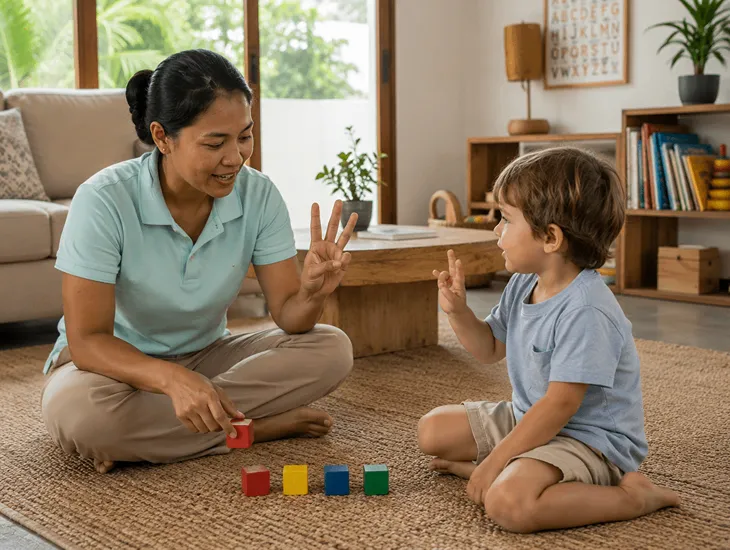
Babysitter Are Covert Tutors 2026 – Professional caregiver teaching a child to count colorful blocks
author-2

Babysitter Are Covert Tutors: How Everyday Care Turns into Real Learning

Expat parents in Indonesia face challenges securing reliable childcare. Finding someone who actively supports early childhood development remains a top priority for busy working families establishing their new lives abroad.

Basic supervision keeps children safe but often neglects vital cognitive growth. Passive supervision often misses valuable early learning windows during a child’s formative years, delaying essential communication and emotional milestones.

Leaving children with untrained individuals can lead to behavioral issues over time. Without structured engagement, toddlers miss crucial opportunities to develop language and social skills daily in their home environment.

Reliable education starts long before formal preschool begins. You can review early childhood guidelines on the Indonesian Ministry of Education and Culture website for baseline developmental standards and national educational expectations.

Trained professionals transform routine tasks into educational moments seamlessly. Realizing that Babysitters Are Covert Tutors changes how you view daily domestic support entirely, elevating your expectations for home care services.

Our dedicated service provides caregivers who actively stimulate young minds. We ensure every interaction builds essential skills for your child’s future academic success, providing peace of mind for busy working parents.

Everyday Caregiving as Early Education

Science shows that frequent conversations accurately predict vocabulary growth. Responsive caregiving directly influences later academic skills in young children, establishing a strong foundation for future reading and writing comprehension.

Children in high-quality care environments show excellent cognitive outcomes consistently. Warm and engaging interactions provide the necessary foundation for intellectual development, ensuring children feel safe enough to explore new concepts.

The adult acts as a knowledgeable guide during daily activities. They scaffold new skills slightly beyond the child’s current ability level, encouraging continuous growth without causing unnecessary frustration or anxiety.

This intentional approach turns standard care into structured learning easily. Caregivers narrate actions and ask questions to stimulate continuous cognitive engagement, transforming mundane tasks into valuable brain-building exercises for toddlers.

You must understand that babysitters act as covert tutors in practice. They maximize learning opportunities without using formal lesson plans, ensuring children receive constant educational support throughout their normal daily routines.

Positioning your home support this way maximizes your child’s cognitive development. Everyday routines become a powerful tool for early childhood education, proving that quality caregiving is an essential investment for families.

Language and Literacy Development Routines

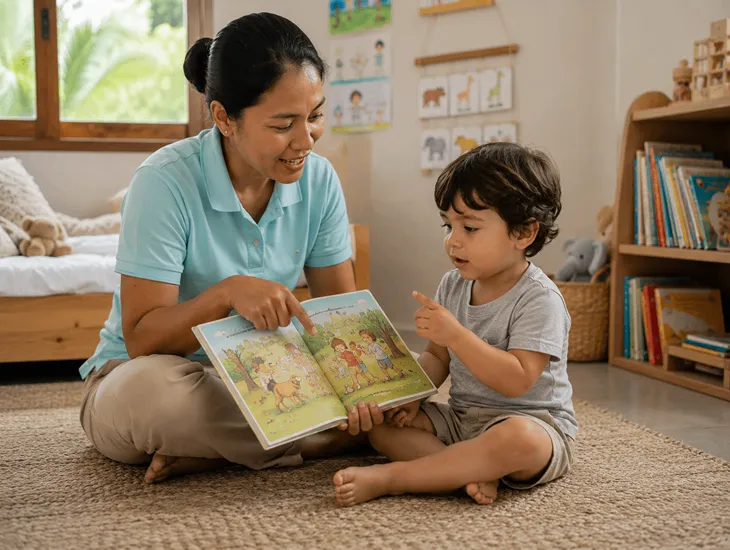
Babysitter Are Covert Tutors 2026 – Caregiver reading a storybook to an engaged toddler in a room

Regular conversation during meals builds significant language processing skills. Caregivers use these specific moments to expand a child’s vocabulary naturally, introducing new descriptive words while discussing food and daily events.

Book sharing goes beyond simply reading words aloud to children. Dialogic reading involves asking prediction questions and making personal connections, which improves both expressive and receptive language abilities over time.

Professionals ask children to recount their day in detail. This everyday narrative practice builds core literacy and sequential thinking foundations, teaching children how to structure stories with a clear beginning and end.

Caregivers name objects consistently during routines to reinforce word association. They expand on simple words to model correct sentence structures, providing clear audio templates for young learners to mimic daily.

Singing simple cleanup songs connects responsibility with verbal practice. These auditory routines help toddlers process instructions and improve active listening, creating a positive association with following rules and completing daily tasks.

Trained professionals ensure every interaction involves rich language modeling. They provide a language-dense environment crucial for bilingual expat households, supporting rapid vocabulary acquisition in a safe and familiar domestic setting.
Numeracy and Problem Solving Skills

Informal math practice occurs naturally during simple daily routines. Caregivers count steps or sort toys by color to build basic number sense, seamlessly integrating quantitative reasoning into normal playtime activities.

Comparing sizes and talking about time intervals introduces abstract concepts early. This helps children grasp complex mathematical ideas through concrete examples, setting a strong foundation for future classroom learning success.

Puzzles and block building relate directly to later academic performance. Caregivers describe spatial positions to enhance spatial awareness and logical thinking, encouraging children to visualize shapes and structures critically.

Letting a child help plan a snack introduces simple sequencing. They learn cause and effect by choosing ingredients and setting the table, bridging the gap between practical life skills and logic.

Structured play methods turn games into opportunities for math development. Caregivers guide the child without taking over the actual problem-solving process, fostering independence and resilience when facing difficult physical challenges.

Recognizing that babysitters act as covert tutors helps parents value these activities. Everyday play lays the groundwork for formal math education, ensuring toddlers enter preschool with robust numerical and spatial comprehension.

Building Executive Function and Self Regulation

Working memory and cognitive flexibility require regular daily practice. Games with shifting rules train core executive functions effectively, helping children learn how to adapt to changing environments and expectations quickly.

Consistent schedules and clear expectations help children develop strong self-control. Countdowns before transitions reduce resistance and improve overall behavioral adaptability, making daily routines smoother for both the child and caregiver.

A calm caregiver coaches deep breathing during frustrating moments. They name feelings to deliver practical social and emotional learning safely, teaching children how to process anger without resorting to physical tantrums.

Turn-taking games teach patience and the delay of gratification. These vital skills tie directly to better school performance and positive classroom behavior, preparing toddlers for the social demands of group learning.

Managing daily routines requires a child to remember specific steps. Packing a bag or organizing a room trains their working memory practically, reinforcing personal responsibility and careful attention to detail.

Professionals use positive discipline to manage challenging behaviors safely. They guide children through conflicts using clear and constructive verbal steps, focusing on long-term behavioral correction rather than short-term punitive measures.

Real Story: Finding Educational Support in Canggu

Marcus struggled to balance demanding investor calls with his active three-year-old son in Canggu. He initially hired a casual helper to manage the toddler while he focused on his tech startup.

The helper relied heavily on a tablet to keep his son quiet. Marcus soon noticed his son throwing massive tantrums whenever the screen was turned off, disrupting the entire household daily.

He realized this passive supervision was actively harming his son’s emotional regulation. He needed a professional who could engage his son constructively, turning the long days at home into positive learning experiences.

Marcus contacted our agency to secure a trained childcare specialist. The new caregiver implemented structured play and eliminated digital distractions to create a healthy learning environment for the active toddler.

The specialist used daily walks to teach colors and numbers naturally. The toddler became calmer, started speaking in longer sentences, and learned to manage his frustration when transitioning between different activities.

Marcus saw firsthand how babysitters act as covert tutors in reality. He now works peacefully while his son receives high-quality early education, proving that trained professionals deliver measurable developmental results daily.

Social Emotional Skills and Peer Behavior

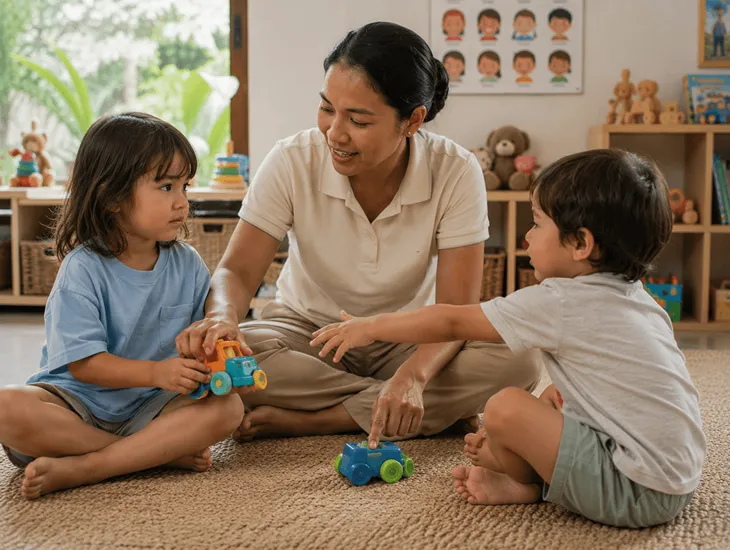
Babysitter Are Covert Tutors 2026 – Caregiver guiding two young children to share toys peacefully

Guided peer interactions help children practice empathy and perspective-taking. Caregivers teach toddlers how to negotiate toys and resolve conflicts peacefully, providing a safe framework for navigating complex social dynamics early.

Labeling emotions validates a child’s feelings during a breakdown. Suggesting collaborative strategies supports deep emotional literacy and long-term resilience, equipping children with the tools needed to handle future social challenges.

A stable caregiver becomes a vital secondary attachment figure. This strong bond associates directly with better emotion regulation and social competence, giving children the security required to explore unfamiliar environments.

Role-playing school scenarios prepare older children for classroom dynamics. They practice asking for help and joining games with new peers safely, building the necessary confidence to thrive in group settings.

Debriefing daily challenges constructively helps children process negative emotions. Professionals guide these conversations to build confidence and interpersonal problem-solving skills, ensuring children feel heard and supported after difficult social interactions.

Understanding that Babysitter Are Covert Tutors reframes the caregiving relationship. It emphasizes the critical emotional support these professionals provide daily, proving they are essential partners in raising well-adjusted and capable children.

Age Appropriate Learning Activities

Caregivers tailor their educational approach to match specific developmental milestones. Toddler activities focus on shape matching and basic object identification, laying the groundwork for spatial awareness and early visual processing.

Preschoolers require advanced pre-literacy engagement to prepare for formal schooling. Caregivers point out letters in storybooks and play phonetic sound games, bridging the gap between spoken language and written text.

Numeracy for preschoolers involves comparing weights and understanding sequential order. They count physical objects to build a concrete understanding of math, making abstract numbers tangible and easily digestible for young minds.

Early primary children benefit from academic support through engaging games. Caregivers support sight-word reading without relying on rigid academic drills, keeping the learning process fun and completely stress-free for students.

Older children learn organization by packing school bags with a checklist. They use simple visual schedules to plan their upcoming daily activities, fostering fierce independence and excellent time management skills.

Age-specific expertise ensures the child receives appropriate cognitive stimulation continually. This targeted approach maximizes learning outcomes across all critical developmental stages, proving that professional care adapts to your growing family.

Screening Standards for Professional Caregivers

Parents must demand strict vetting for anyone entering their home. Verified childcare experience with specific age groups is an absolute necessity, ensuring the provider understands the unique demands of early childhood.

Reference checks must focus on communication and engagement abilities. Agencies verify a candidate’s capacity to stimulate learning alongside basic safety skills, filtering out applicants who default to passive supervision methods.

Baseline language skills are required to model correct sentence structures. The caregiver must deliver clear instructions in English or Indonesian consistently, preventing confusion and supporting strong bilingual development for expats.

Training programs focus heavily on childhood development milestones. Caregivers learn specific techniques for open questioning and responsive daily conversation, enabling them to transform ordinary moments into powerful linguistic learning opportunities.

Agencies coach staff to turn crafts into executive function exercises. We ensure our professionals understand covert tutoring, guaranteeing they apply these educational theories in your home to support cognitive growth.

FAQs about Babysitter Are Covert Tutors

Q: Why is passive supervision harmful? 

A: Passive care wastes vital learning windows. Children need active engagement to build strong communication skills.

Q: Do caregivers replace formal teachers? 

A: No. They extend learning through play and routines. They prepare children for school without formal drills.

Q: How do caregivers teach executive function? 

A: They use rule-based games and schedules. This trains memory and self-control effectively during daily routines.

Q: What language skills should a caregiver have? 

A: They need strong proficiency to model correct sentences. This allows them to expand a child’s vocabulary naturally.

Q: How can I ensure my caregiver teaches my child? 

A: Hire through a professional agency. Ensure they understand how Babysitter Are Covert Tutors in practice.

Need help finding out how Babysitter Are Covert Tutors, Chat with our team on WhatsApp now!