

Review Us
Parenting in Bali 2026 – Responsive strategies, cultural awareness, and daily routines helping expat families thrive in Bali's dynamic environment
author-2

Parenting in Bali: Tips for Being More Adaptable and Responsive

Moving to Bali with children feels exciting until the first cultural misunderstanding, school transition, or emotional meltdown lands at your feet. What worked back home may not work here. The gap between expectation and reality hits fast, especially for first-time expat parents.

Bali’s environment demands more than copy-paste parenting from your home country. Multilingual classrooms, temple etiquette, mixed social circles, and unpredictable weather all require parents who can read their child’s needs quickly. Rigidity here costs your child’s sense of security.

The pressure compounds when you are also managing remote work deadlines, visa runs, and an unfamiliar healthcare system. Many parents in Bali report feeling stretched too thin to be genuinely present. Children sense that absence — and react to it in difficult, often unexpected ways.

Research consistently shows that warm, stable, responsive caregiving is the strongest predictor of healthy child adaptation in a new country. According to the US National Institutes of Health, secure attachment directly shapes long-term emotional regulation and resilience in children.

The good news is that parenting in Bali does not require perfection — it requires adaptability. Parents who learn to observe their children’s cues, adjust their responses, and embrace local culture give their children a genuine developmental advantage unavailable in most settings.

This guide delivers practical, evidence-based strategies for responsive parenting in Bali that work across different ages, schedules, and cultural contexts. Whether you arrived last month or last year, these tools will help you show up more effectively for your family every day.

Why Responsive Parenting Matters More in Bali

Children relocating to a new country experience a form of low-grade, ongoing stress as they process unfamiliar sounds, faces, languages, and routines. Responsive parenting — being emotionally available, consistent, and attuned — is the most powerful buffer against this kind of developmental disruption for expat children in Bali.

Raising children here is uniquely complex because they simultaneously navigate local Balinese culture, international school environments, expat social circles, and the family’s home-country values. Each layer creates competing expectations. A parent who can pivot calmly between these contexts gives children permission to do the same.

Adaptability is not the same as inconsistency. Children need predictable emotional responses from parents even when the external environment changes daily. The goal is a stable internal compass for your child — one that is set by your warmth and reliability, not by external circumstances.

The research is unambiguous: children with responsive caregivers show better academic outcomes, stronger peer relationships, and healthier emotional regulation. In Bali’s demanding multicultural environment, these advantages are not optional extras — they are survival tools that directly shape how well your child thrives here.

How Balinese Culture Shapes Adaptable Parenting in Bali

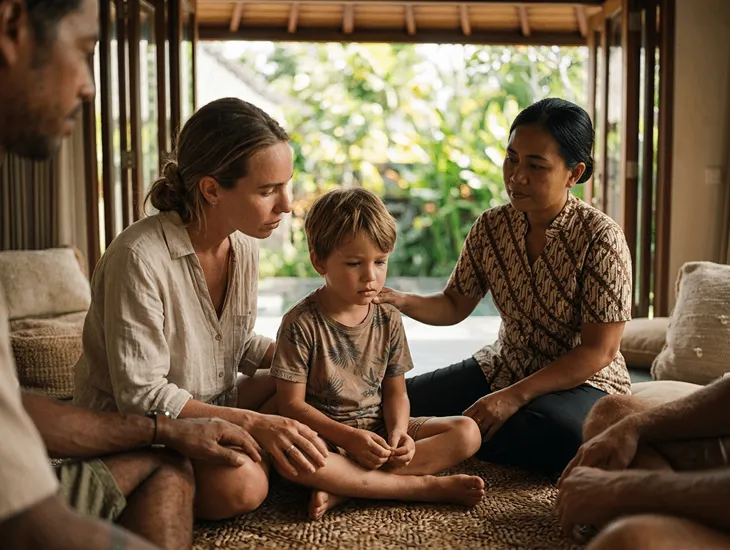
Parenting in Bali 2026 – Balinese cultural ceremonies, community caregiving, and temple etiquette supporting emotionally adaptable expat families

Balinese society treats children as sacred participants in family and community life, not as background figures to be managed. Children attend ceremonies, contribute to household rituals, and interact with elders from an early age. This deep inclusion shapes what respectful, community-aware parenting in Bali looks like in practice.

Expat parents who observe and participate respectfully in these cultural norms — attending temple events appropriately dressed, greeting elders calmly, introducing children to local customs — signal safety and belonging to their children. Kids take cues from parents; when parents engage with dignity, children follow and adapt.

Language accelerates cultural adaptation significantly. Introducing basic Bahasa Indonesia at home — even simple greetings, food words, and directions — reduces daily friction and builds belonging in school settings. A child who can say “terima kasih” to a local vendor feels capable rather than foreign here.

Extended community networks matter here. Balinese caregiving is naturally communal, with grandparents, neighbors, and temple communities all playing roles. Expat parents who tap into local parent groups, school networks, and neighborhood communities recreate this safety net and reduce parenting isolation significantly while living in Bali.
Reading Your Child's Cues in a New Environment

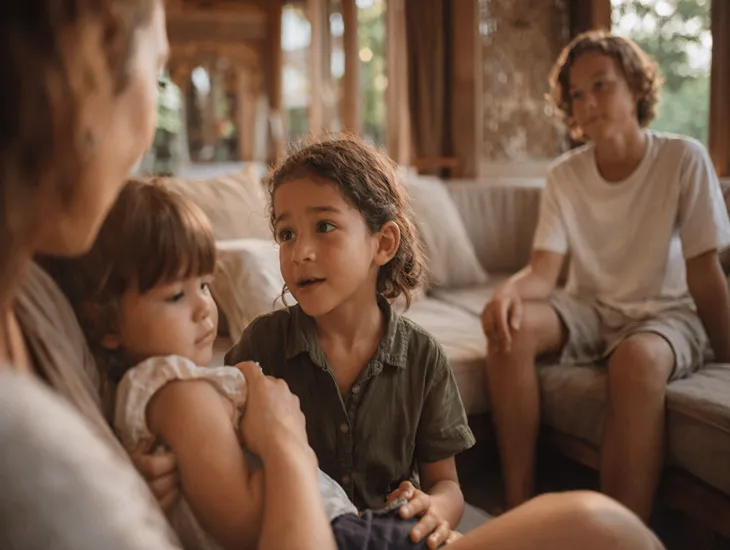
Responsive parenting begins with observation, not instruction. Before reacting to behavior, ask: what is my child actually communicating right now? Withdrawal, irritability, clinginess, or sudden sleep disruption in Bali often signals overstimulation or cultural overload rather than deliberate misbehavior.

Validating emotions before setting limits is the cornerstone of effective responsiveness. Saying “I see you feel overwhelmed — that temple was very loud and crowded” before asking for calm behavior teaches children to name their internal states. This skill, built early, protects mental health across all environments and ages.

Bali’s sensory environment is intense — motorbike traffic, incense smoke, gamelan music, crowded markets. Young children especially need gradual exposure. Parents who introduce these environments slowly, staying calm themselves, help children habituate without developing anxiety around daily Balinese life.

Watch for signs of cumulative stress: frequent tantrums, school refusal, appetite changes, or difficulty sleeping. These are your child’s way of communicating that their nervous system is overwhelmed. A simple daily check-in — “what felt hard today?” — gives children a safe channel to release tension with you.

Daily Routines That Build Security and Flexibility

Predictable routines are the scaffolding of emotional security for children adapting to a new country. Consistent sleep times, regular mealtimes, and familiar morning rituals tell a child’s nervous system that the world is safe and manageable — even when everything outside looks unfamiliar and new.

In the context of raising a family in Bali, routines can be tied to the local environment beautifully. A nightly walk past the neighborhood temple, a Saturday market visit, or a weekly beach outing becomes a family anchor that children look forward to and rely on for emotional grounding every week.

Flexibility within structure is the goal, not rigidity. When plans change — rain cancels an outing, a ceremony closes the road, or a child simply needs a quiet afternoon — model calm adaptation. Say: “Plans changed; let’s choose something else together.” Children learn flexibility by watching their parents navigate change without distress.

Device-free family time must be scheduled deliberately, especially since remote work can blur every boundary. Designate dinnertime, bedtime, and weekend mornings as phone-free. When children see parents consistently choosing presence over screens, they internalize that they are genuinely valued and important each day.

Real Story: How One Family Adjusted Their Approach in Seminyak

Meet Daniel, a 41-year-old software architect from Canada, who moved to Seminyak with his partner and their two children aged five and nine. Within three months, his older child began refusing school, complaining of stomachaches every morning. Daniel initially pushed harder — firmer rules, earlier bedtimes, stricter homework schedules. The situation worsened noticeably.

A local school counselor suggested Daniel explore responsive parenting resources for expat families in Bali. He described the turning point: “I was sitting on the terrace one evening, the smell of incense drifting over from the house temple next door, and my daughter finally told me she felt invisible at school because she didn’t understand anyone.”

Daniel made three immediate changes. He started a ten-minute evening check-in ritual after dinner, asking both children “what felt hard today?” He enrolled his daughter in a small Bahasa Indonesia class on weekends in Kerobokan. And he deliberately shifted from problem-solving mode to listening mode for the first thirty seconds of every difficult conversation.

Within six weeks, the school refusal had stopped. His daughter was speaking basic Indonesian with the family’s local helper and greeting neighbors by name. “I stopped trying to fix everything,” Daniel said, “and started actually hearing them. That changed everything. Bali didn’t get easier — I got more responsive.”

Age-Appropriate Responsiveness for Families in Indonesia

Responsive Families in Indonesia 2026 – Age-specific communication strategies, cultural routines, and emotional attunement for expat children at every stage

Responsiveness looks different at every developmental stage, and adapting your approach by age is critical for effective parenting in Bali. For infants and toddlers aged zero to three, responsiveness means consistent physical presence, calm tone, and predictable daily rhythms. Introducing them to local sounds and environments gradually builds healthy sensory tolerance.

Children aged three to six benefit most from simple emotional labeling. When your preschooler is overwhelmed at a temple visit, naming the feeling — “that was loud and you felt scared” — before moving on validates their experience. Short visits, familiar snacks, and a calm parent voice are your most powerful tools during these early years.

Primary-school children aged six to twelve need structured flexibility. Encourage participation in local cultural activities — Balinese dance, gamelan, swimming — while keeping academic routines consistent. At this age, children begin forming cultural identity; parents who engage actively alongside them, rather than dropping them off, build stronger trust and connection in Bali.

Teenagers respond best to autonomy within clear boundaries. Involve them in decisions about activities, social commitments, and family routines. According to family and education resources, adolescents who feel genuinely consulted show higher engagement, better behavior, and stronger family loyalty across diverse cultural environments like Bali.

Managing Work-Life Balance Without Losing Connection

For remote-working parents, the boundary between work and family time is the most critical — and most violated — line in Bali. Unlimited connectivity means unlimited work intrusion. Children who receive inconsistent parental attention due to blurred work hours develop anxiety and attention-seeking behavior that escalates over time if left unaddressed.

Use Bali’s coworking infrastructure deliberately. Canggu, Ubud, and Seminyak offer well-equipped spaces that separate work from home. Parents who do deep work in coworking spaces and then return home fully present — not half-available at a laptop — report dramatically better family dynamics and lower household conflict overall.

Nannies and local helpers are valuable but must be deployed strategically. Their role is to create space for quality family interaction, not to substitute for parental presence. Parents who protect evening and weekend family time report stronger emotional bonds and lower household conflict overall in Bali.

Self-care is not indulgence — it is structural maintenance for responsive parenting. A depleted parent cannot regulate their own emotions, let alone attune to a child’s needs. Bali’s yoga spaces, swim spots, and quiet rice-field paths offer accessible daily renewal that directly improves the quality of the parenting you bring home to your family.

Common Mistakes That Undermine Adaptable Parenting

Overstructuring a child’s schedule in an attempt to create certainty is a common mistake. When parents pack every afternoon with tutoring, sports, and activities, children have no time to process their environment. Unstructured play and quiet time in Bali’s open spaces are not wasted time — they are essential for emotional integration and healthy development.

Avoiding cultural engagement out of discomfort is another significant missed opportunity. Parents who maintain a parallel expat bubble — never engaging with Balinese neighbors, ceremonies, or community life — deprive their children of the cultural confidence that makes long-term life in Bali genuinely enriching and meaningful for the whole family.

Reacting to behavior without investigating the cause is perhaps the most common responsiveness failure. A child acting out at school, refusing food, or becoming clingy is communicating something important. Responsive parenting in Bali means pausing to ask “what is this behavior telling me?” before responding with consequences or corrections of any kind.

Expecting your child to adapt faster than is developmentally realistic creates unnecessary pressure. Full cultural adjustment typically takes twelve to eighteen months. Parents who maintain warmth through difficult phases raise children who emerge more resilient, empathetic, and globally capable over time.

FAQs about Parenting in Bali

Q: What makes parenting in Bali different from parenting in other expat destinations?

A: Bali’s mix of deep local culture, expat community, and remote work pace demands uniquely flexible responses.

Q: How long does it take for children to adapt to life in Bali?

A: Most children need 12–18 months for full cultural and social adjustment to Bali’s environment.

Q: Should I enroll my child in a local or international school in Bali?

A: Both work; choose based on your stay length, child’s age, and language comfort level in Bali.

Q: How do I balance working remotely with being a present parent in Bali?

A: Use coworking spaces for focused work, then return home fully present with device-free family time.

Q: At what age should I introduce Bahasa Indonesia to my child in Bali? 

A: Start as early as possible; toddlers absorb language fastest and benefit most from early exposure.

Q: How do I know if my child is struggling emotionally with the move to Bali?

A: Watch for sleep changes, appetite shifts, school refusal, or unusual clinginess as early warning signs.

Need help navigating parenting in Bali? Chat with our team on WhatsApp now!